
Key Golf Course Design Principles: Strategy, Playability, Fun
This post contains affiliate links. As an Amazon Associate, we earn from qualifying purchases.
Golf course design principles are the five core concepts, aesthetics, naturalness, playability, originality, and strategy, that architects use to shape the land into a compelling, functional, and sustainable playing field. These principles guide every decision, from the initial routing to the placement of a single bunker, balancing artistic vision with the practical realities of construction, maintenance, and golfer experience.
That framework sounds academic. It isn’t. The difference between a forgetable round and one you remember for years hinges on how these principles are weighted and woven together. A 2007 study at TPC Craig Ranch revealed a clear split: PGA professionals prioritize playability and strategy, while amateurs are drawn first to aesthetics and naturalness. Your favorite course probably nails the balance for your skill level.
What follows is a breakdown of each principle, the physical and psychological effects they create, and how architects like Tom Doak or firms like Coore and Crenshaw apply them. You’ll also see where designs fail, when a stunning view leads to a blind shot nobody can play, or when a maintenance budget can’t keep up with the architect’s vision.
Key Takeaways
- The five established principles are aesthetics, naturalness, playability, originality, and strategy. They are tools, not rules, and their weighting changes a course’s character.
- Routing is the invisible first principle. A poor sequence of holes can render a beautiful site unplayable or financially unsustainable before a single shovel hits the ground.
- Playability is not about making the course easy. It’s about providing clear, strategic options for all skill levels, often through width and multiple routes to the green.
- A course must be maintainable within its budget. A brilliant design that requires a $750,000 maintenance budget to look right will fail a club with only $400,000.
- Environmental sustainability is now a foundational layer, integrated into modern principles through standards like the Sustainable Golf Development (SGD) Voluntary Sustainability Standard.
The Five Core Design Principles (And What They Mean)
Forget vague ideas about “beautiful” or “challenging” courses. The profession operates on five defined principles. A 2010 academic thesis formally identified them as aesthetics, naturalness, playability, originality, and strategy. Each one answers a different question for the golfer.
The five design principles of golf course architecture, aesthetics, naturalness, playability, originality, and strategy, merge to provide a playing field which players of differing skill levels can enjoy. These principles guide the implementation of design elements like greens, tees, fairways, and hazards on the landscape.
Aesthetics is about visual appeal. It’s the first impression. This principle asks if the course is pleasing to the eye, do the shapes of bunkers flow with the land? Does the framing of a green by trees or water create a memorable picture? Arnold Palmer Design Company lists beauty as its first tenet, arguing a course should be an “oasis” from urban chaos. But aesthetics can’t stand alone. A gorgeous hole that is brutally unfair or impossibly expensive to maintain is a failure.
Naturalness refers to how well the course appears to belong to its site. It’s the illusion that the holes were discovered, not built. This principle uses existing landforms, ridges, valleys, streams, and native vegetation. The goal is to blur the line between the natural and the man-made. A course high in naturalness often has lower construction costs because it moves less earth.
Playability is the most misunderstood principle. It is not about dumbing down the course.
Where this goes sideways: Equating playability with low scores. A playable course offers recovery options, avoids relentless punishment, and provides a fair test for the golfer’s actual skill. It means a 20-handicap can find their ball and finish the hole, while a scratch player is challenged by the strategic choices. The American Society of Golf Course Architects (ASGCA) emphasizes that playability includes safety and logical flow. A hole where players constantly wait for the group ahead to clear a blind crest is not playable, regardless of its length.
Originality is the fingerprint of the architect and the site. It’s the avoidance of cliché. An original course presents holes that feel new, with unique hazards, green complexes, or tactical dilemmas. Tom Doak has argued that the best course offers the “greatest variety in all facets of design.” Copying the Road Hole from St. Andrews doesn’t count.
Strategy is the intellectual layer of golf. It’s the principle that asks a golfer to think. Strategic design presents multiple routes to the hole, each with varying degrees of risk and reward. A bunker shouldn’t just punish a bad shot; it should make a golfer consider playing away from it, perhaps into a narrower landing area. Alister MacKenzie, the co-designer of Augusta National, wrote that bunker banks should slope so a ball always rolls to the middle, a specific design rule that serves strategic punishment.
| Design Principle | The Question It Answers | A Weak Example | A Strong Example |
|---|---|---|---|
| Aesthetics | “Is this pleasing to look at?” | Flat, featureless land with no visual framing. | A green set against a backdrop of mature pines or a coastal dune. |
| Naturalness | “Does this feel like it belongs here?” | Massive, imported soil mounds on a flat prairie. | A fairway that follows the natural roll of a hillside. |
| Playability | “Can golfers of different abilities enjoy this?” | A forced carry over a canyon that 60% of players cannot clear. | A wide fairway with a bunker that challenges better players but can be easily avoided. |
| Originality | “Have I seen this before?” | A generic, straight par-4 with two side bunkers. | A drivable par-4 with a green encircled by a deep, natural depression. |
| Strategy | “Do I have to think about my shot?” | A hazard placed randomly in the rough. | A bunker placed at the ideal landing zone, forcing a choice between safety and advantage. |
How Routing Decides If a Course Succeeds or Fails
Before any principle is applied, an architect must solve the routing puzzle. This is the sequence of 18 holes across the landscape. Get it wrong, and nothing else matters.
I recall reviewing a new course where the owner had designed the routing himself. He was obsessed with a dramatic canyon that split the property. He routed several holes to play directly over it. On opening day, they discovered most players couldn’t carry the canyon. The course was literally unplayable for its intended market and had to be hastily, and expensively, redesigned.
That story mirrors one shared by European Golf Design’s Robin Hiseman. A logical, walkable routing is the foundation. The routing of a golf course determines walkability, safety, construction cost, and whether the holes find the property’s best natural features.
A routing interface with clear visual hierarchy and minimal clicks to common destinations feels intuitive. It finds “natural golf holes,” as Hiseman says, often by identifying a few perfect green or tee sites and connecting them. It also thinks in practical terms: * Construction: Can earthmoving be balanced (cut and fill) to reduce trucking costs? * Maintenance: Can the maintenance team access all areas efficiently? * Environment: Can drainage water be collected for irrigation? * Experience: Does the course return to the clubhouse after 9 holes?
The American Society of Golf Course Architects design page stresses that involving an architect early for schematic design is critical to navigate these complexities. A great routing makes the application of the five principles possible. A poor one sabotages them from the start.
The Hidden Sixth Principle: Buildability and Budget
Architecture doesn’t end on paper. A design must be buildable and, crucially, maintainable. This is the pragmatic layer that underpins all the artistry.
Scott Macpherson’s design philosophy states it bluntly: “Failure by the architect to design a course that can be maintained within the budget may mean that…the quality of the playing conditions are sub-optimal.” You can design the most strategic, beautiful greens in the world, but if they require a $100,000 annual sand budget and a team of 10 to maintain, a public daily-fee course will never keep them in shape. The design literally withers on the vine.
This ties directly to the ASGCA practical golf facility guide, which outlines the planning team needed for a successful project. The golf course superintendent is a key voice, advising on grass selection, irrigation needs, and long-term maintenance labor. Ignoring this is how projects blow budgets and clubs go bankrupt.
Three essential practical checks: Water: Is there a sufficient, legal source of irrigation water? No course will be suitable if it sits wet, and no turf will survive without water. 2. Soil: Can the native soil support turfgrass, or will it require massive importation? 3. Circulation: Can maintenance vehicles get to every hole without crossing play or damaging sensitive areas?
These questions aren’t glamorous. They decide whether a great golf course exists for more than its opening season.
Where Modern Principles Are Evolving: Sustainability and Inclusivity
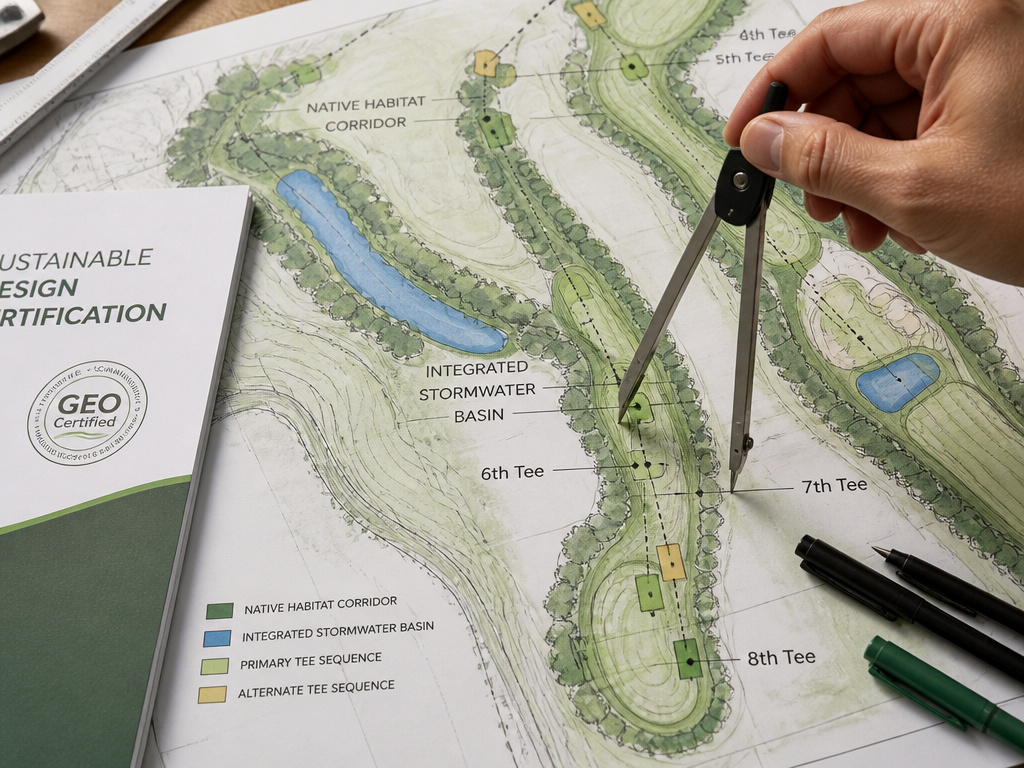 The classic five principles are being framed within two modern imperatives: environmental sustainability and broader accessibility.
The Sustainable Golf Development (SGD) Voluntary Sustainability Standard formalizes this shift. It groups sustainability under three headings: Nature (conservation), Resources (efficiency), and Community (legacy). This isn’t just about planting wildflowers. It’s about golf course sustainability principles PDF that mandate stormwater management, habitat corridors, and water quality protection from the earliest planning stages.
Inclusivity is expanding the principle of playability. It’s about designing forward tees that are true strategic options, not afterthoughts. It’s about considering shorter, fun-focused formats like 12-hole or par-3 courses that require less land and time. The industry is slowly shifting from the “7,000-yard par-72” obsession to designs that welcome new players. This reflects a return to the principles of minimalist design, where width, strategic options, and fun are prioritized over sheer difficulty.
This evolution is visible in the work of Coore and Crenshaw and Tom Doak. Their naturalistic approach inherently promotes sustainability (less earth moved, more native areas) and often creates more playable, engaging courses for a wider range of skills.
Frequently Asked Questions
What is the most important golf course design principle?
There isn’t one single most important principle. The art is in the balance. However, if the routing is flawed, no other principle can save the course. For the golfer’s day-to-day experience, playability is paramount, a course must be functional and enjoyable for its intended audience.
How do golf course architects use these principles?
Architects use the principles as a checklist and a creative framework. When evaluating a site, they ask: How can I create strategy here? What are the natural features to highlight? Will this green complex be playable? They constantly weigh these priorities against the practical constraints of budget and buildability.
What’s the difference between strategic and penal design?
This is a core design philosophies distinction. Penal design simply punishes a missed shot with a lost ball or a difficult recovery. Strategic design presents a choice: a riskier route for a potential reward, or a safer route with a longer, more difficult next shot. Strategic design makes you think. Penal design just makes you pay.
Can a golf course be too natural?
Yes. A completely untouched piece of land might not contain 18 interesting golf holes. The architect’s job is to enhance the natural landscape for golf, sometimes making bold alterations that appear natural. The principle aims for harmony, not total absence of human intervention.
How long does it take to design a golf course?
The full process, from initial site evaluation and routing to finished construction drawings, typically takes 12 to 24 months for an 18-hole course. This doesn’t include the time for market studies, permitting, or the actual course construction, which can add several more years.
Before You Go
Look at your home course differently now. That bunker isn’t just a hazard; it’s a strategic tool. The width of the fairway is a deliberate playability choice. The flow of the holes is the result of a routing plan that probably considered a dozen alternatives.
The principles aren’t abstract. They explain why you love some holes and dread others. They explain why the Golden Age of golf course design produced so many enduring classics, architects like MacKenzie prioritized strategy and naturalness in an era before massive earthmoving equipment forced a different approach.
Ultimately, great golf course architecture respects the land, challenges the mind, and remains a viable business. The next time you play, notice the choices the architect made.
