
How to Hit a Flop Shot | The Lie That Decides It in 3 Seconds
This post contains affiliate links. As an Amazon Associate, we earn from qualifying purchases.
This post contains affiliate links. As an Amazon Associate, we earn from qualifying purchases.
To hit a flop shot, use your highest-lofted wedge, open the clubface and your stance, position the ball forward, and make a committed, accelerating swing that strikes the turf. The shot’s success hinges on matching your technique to the lie, good grass lets the bounce work; tight lies or into-the-grain grass demand specific adjustments to avoid a thin or dead shot.
That last clause about the lie is the whole game. Most guides treat the flop as one swing. It isn’t. The grass under your ball dictates your weight, your ball position, and how much speed you need. Get that wrong, and the ball either rockets over the green or dies in the hazard.
What follows: the three non-negotiable setup specs, the swing thought that prevents a chunk, and a breakdown of how to read four different lies, including the tricky into-the-grain situation Phil Mickelson has a name for.
Key Takeaways
- The lie decides everything. A good lie with cushion lets the club’s bounce work. A tight lie on firm ground brings the thin shot into play and requires a more forward ball position and handle lean.
- Pros disagree on weight distribution. Ben Crenshaw advocates 75% weight on the right side for a cut shot; Dan Grieve says 70-80% on the left foot. The lie is the tiebreaker, use Grieve’s method for standard flops, Crenshaw’s for a specific high cut.
- You must strike the ground. Trying to help the ball up leads to a thin, bladed disaster. The club’s bounce is designed to glide; let it.
- For an into-the-grain lie, commit to more speed. The grain holds the club under the ball, so it comes out “slow.” Mickelson’s advice is to try to fly it halfway to the hole.
- If the ball is in a terrible lie, don’t attempt the flop. Play a lower, safer pitch shot or a bump and run.
The Tool You Actually Need
Forget just grabbing your most lofted wedge. The spec that matters is bounce, the angled area on the sole that prevents the leading edge from digging.
Your lob wedge (58-60 degrees) has the loft. Your sand wedge often has more bounce. In standard conditions, the lob wedge is the default. In thick rough, a sand wedge’s heavier flange and bounce can slide through better.
The club’s bounce angle is its forgiveness. On a proper flop, the sole should brush the turf, not the leading edge. A wedge with insufficient bounce for your swing will dig, turning a flop into a chunk.
| Wedge Type | Typical Loft | Best For Flop Shots When… | Risk If Misapplied |
|---|---|---|---|
| Lob Wedge | 58° – 60° | Standard lies, maximum height | Digs in soft turf if bounce is too low |
| Sand Wedge | 54° – 56° | Thick rough, higher bounce needed | Launches lower, requires more face manipulation |
| Gap Wedge | 50° – 52° | Not recommended for true flops | Ball comes out too hot, no stopping power |
The choice isn’t permanent. If you’re struggling from the rough, try the sand wedge. If you need the utmost height from a clean lie, it’s the lob wedge. This is a form of shot shaping, selecting the tool for the required trajectory.
The Setup That Creates Height
Head design changes the entire process. Look at the business end of your trimmer. You need three alignments: open clubface, open stance, forward ball position.
Open the clubface first, then grip. Rotate the face away from the target before you take your normal hold. This adds effective loft and exposes the bounce. If you grip then try to open the face, you’re just weakening your grip and losing control.
Your stance should be wide for stability and open. Pull your front foot back so a line across your toes points left of the target. This opens your shoulders, which sets the swing path.
Place the ball off your front heel. For a standard flop, let the shaft lean slightly away from the target, so the grip points near your belt buckle. This de-lofts the club? No. It actually adds loft and helps present the bounce.
Common mistake: Setting up with a narrow, square stance. This forces a steep, digging swing path. The flop needs an out-to-in, gliding motion, which only an open stance enables.
Now, the great weight debate. Instruction from Dan Grieve says 70-80% of your weight should be on your front foot. This keeps the low point of your swing just behind the ball, letting the bounce slide under it. Ben Crenshaw’s method for a specific cut shot places about three-quarters of the weight on the right side. This helps create an upward, outward swing path for extreme height.
Which is right? Both. Grieve’s method is the bedrock for most flop shots, it’s reliable. Crenshaw’s is a specialist variation for when you need a towering cut, like hitting over a tree. Start with weight forward.
The Swing: Trust the Loft
The swing is a rejection of instinct. You see a high shot, so you want to lift. That’s how you blade it over the green.
Take the club back with a pronounced wrist hinge. Feel your lead wrist cup, keeping the face open. The length of your backswing controls distance, a longer swing for more carry, a shorter one for less. Your tempo stays constant.
The downswing is where you commit. Accelerate through the ball and hit the ground. The club should brush the turf for inches after impact. This is the bounce at work. If you try to scoop, the leading edge strikes the ball’s equator. That’s a thin missile.
Let the loft of the club point back at your face in the follow-through. This visual cue ensures you’ve maintained the open face and used the bounce, not the edge.
Your follow-through should mirror your backswing length. Decelerating is the death move. It causes fat contact or a complete miss. The swing thought isn’t “high.” It’s “brush and turn.”
This full, committed motion is different from the controlled, abbreviated action of a partial wedge shot. A flop uses speed to generate height; a partial wedge uses less speed for precision.
What’s the One Thing You Must Check Before a Flop?
 The lie. It’s the pre-shot audit that tells you whether to proceed, adjust, or bail.
A good lie with a cushion of grass is flop territory. The bounce can interact with the grass as designed. A bad lie, buried, hardpan, no grass, is a red flag. Attempting a flop here is low-percentage. Choose a punch shot or a bump and run shot instead.
For the in-between lies, your setup changes.
Tight Lie (Firm Ground, Little Grass): The threat is the thin. Move the ball slightly back in your stance. Lean the handle slightly forward. Take a slightly steeper, more descending blow. This guards against the leading edge skidding into the ball.
Into-the-Grain Lie: The grass grows toward you. This is the “Phil” shot. The grain will hold the club under the ball, so it comes out with less energy. Mickelson’s advice is to commit to more speed, try to fly the ball halfway to the hole, because it will come out “slow.” Keep some weight forward because the club wants to bounce.
Downgrain Lie: The grass grows away from you. The club will bounce more readily. Here, you must keep your weight forward to control the bounce and avoid hitting too far behind the ball.
These adjustments are as critical as understanding how to play from an uphill lie or a downhill lie. The slope changes your baseline; the lie changes your technique.
When Not to Hit a Flop Shot
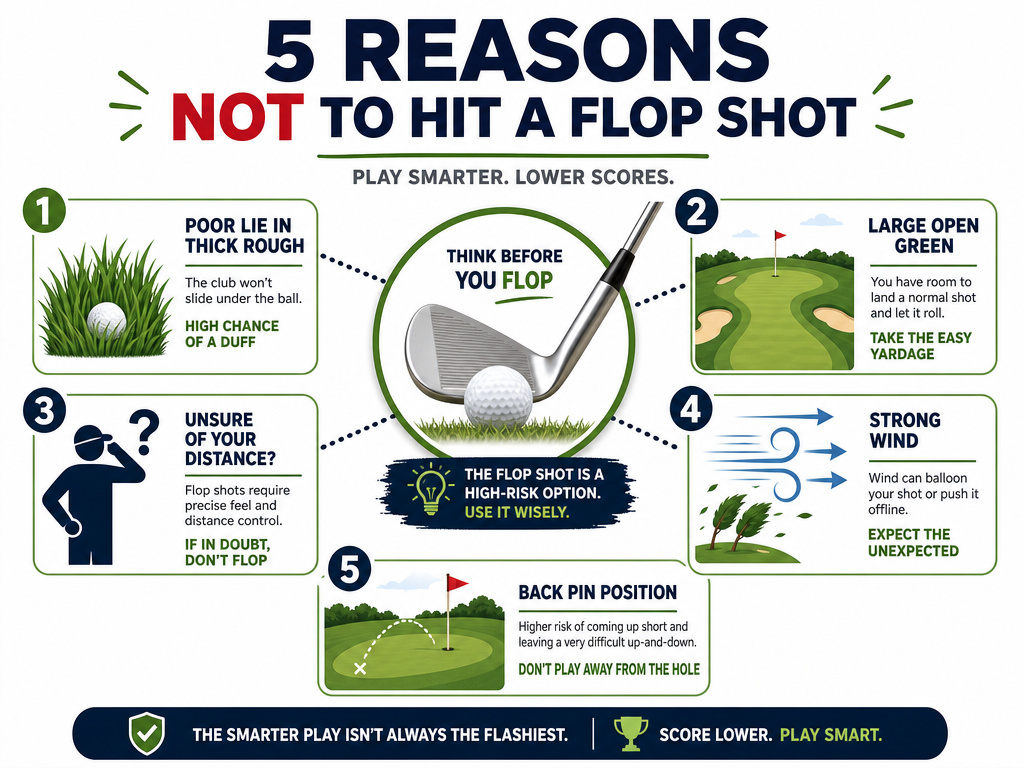 The flop is a spectacular solution to a specific problem. It is not a default short-game shot.
Do not hit a flop if: * The lie is poor. The risk drastically outweighs the reward. * You have green to work with. A lower chip and run or pitch is more reliable. * You’re not confident. Doubt leads to deceleration, which leads to disaster. * The wind is strong. A headwind will kill it; a tailwind will blow it over the green. * The pin is far back. You need the ball to release, not stop dead.
The flop is for when you’re short-sided with an obstacle in front and a tight pin. It’s a scoring shot, not a saving shot. Overuse it and your scores will balloon. It’s the opposite of a reliable stinger off the tee, one is for show, the other is for control.
Frequently Asked Questions
What wedge is best for a flop shot?
58 or 60-degree lob wedge is the standard choice for maximum loft. However, a sand wedge with higher bounce can be better from thick rough. The key is having enough bounce to glide through the turf, not dig.
Why do I keep hitting my flop shot thin?
You are likely trying to help the ball into the air by scooping or not committing to striking the ground. This causes the leading edge to strike the ball’s equator. Focus on accelerating through impact and letting the club’s bounce brush the turf after the ball.
Should my weight be forward or back for a flop shot?
For a standard flop, most modern instruction recommends 70-80% of weight on your front foot. This promotes a slight downward strike that engages the bounce. A specialist shot, like Ben Crenshaw’s cut, uses more weight on the back foot to create a steeper, upward strike.
Can you hit a flop shot from a tight lie?
Yes, but it’s higher risk. Adjust by playing the ball slightly back in your stance, leaning the handle forward, and taking a more descending blow. This helps avoid hitting the ball thin. Many pros would choose a different shot altogether.
How far can you hit a flop shot?
Full flop shot with a lob wedge can carry up to 30-40 yards for most golfers. With a longer, more aggressive swing like Crenshaw describes, accomplished players can hit a high cut up to 100 yards. It’s about swing length and speed, not muscle.
The Bottom Line
The flop shot isn’t a magic trick. It’s a mechanical response to a specific situation, governed by the lie at your feet. Nail the setup, open face, open stance, ball forward, and make a committed swing that trusts the bounce to do its job. Remember Crenshaw’s weight-back method for a specialist high cut, and Mickelson’s speed tip for into-the-grain lies. But when the lie says no, have the discipline to hit the low-trajectory punch instead. That’s how you save strokes, not just impress your friends.
